
Introduction
In the realm of medical health, a minuscule, invisible component defect can lead to implant failure, inaccurate diagnostic device readings, or even directly endanger a patient’s life. However, end-users and even some procurement officers often focus solely on the brand and functionality of medical equipment, lacking a deep understanding of the manufacturing precision and reliability of their core parts.
It is because there is a large barrier in terms of professionalism within the field of Medical Device Manufacturing. Apart from being simply an issue about forming metals or plastics, this is a very integrated field with the application of engineering, quality management systems such as ISO 13485, as well as material sciences, requiring a high level of tolerance control.
In this article, we will be exploring how CNC machining, more precisely CNC turning and milling, solves these issues in manufacturing through digital and automation methods, providing a good physical foundation for Precision Health Technology.
What is High-Precision Medical Component Manufacturing, and Why Does It Far Exceed Ordinary Machining?
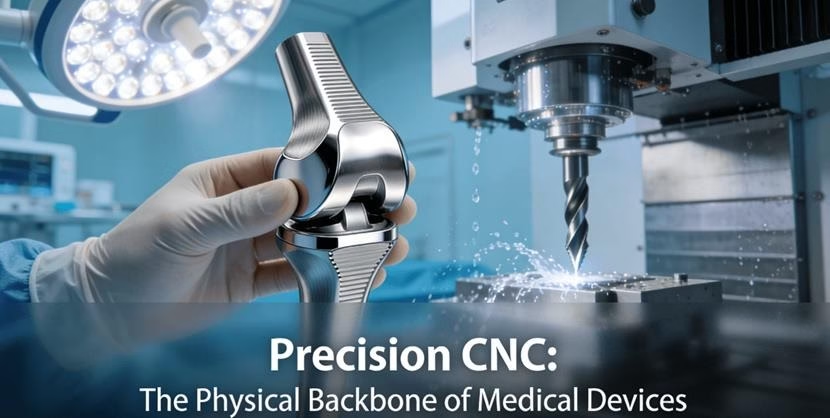
Medical parts manufacturing implies the fabrication of CNC Machined Medical Parts for life-critical applications that include bone screws, joints of a surgical robot, and complex elements of an endoscope. The specificity of this type of manufacturing is not limited to micromachining but includes such criteria as medical suitability, such as biocompatibility, sterilization, and in vivo stability.
The main distinction from general-purpose machining consists of that “precision,” which medical parts require, implies dimensional or geometric tolerances on a micrometer (µm) or even sub-micrometer scale. A slight discrepancy of several microns in clearances between the artificial knee insert and femoral components will greatly affect the wear rate and comfort of a patient’s movement. Such precision implies safety and effectiveness. Its achievement involves overcoming a number of technical obstacles related to materials science, advanced CNC Milling Programming, and metrological processes involved.
From Titanium Alloys to PEEK: How Are Medical Materials Formed via CNC Technology?
Problem Statement: Material Properties and Machining Challenges for Medical Components
The choice of material such as Ti-6Al-4V, 316L stainless steel, and PEEK stems from their suitability in terms of mechanical and biocompatibility characteristics for manufacturing implants and medical equipment. At the same time, each material poses different machining challenges: work hardening and galling for titanium; thermal distortions for stainless steel; and heat sensitivity of PEEK.
l Metal Materials: Ti-6Al-4V Titanium Alloy and 316L Stainless Steel
The Ti-6Al-4V titanium alloy is an optimal material that provides high strength, a low elastic modulus, and biocompatibility necessary for implants. 316L surgical grade stainless steel, known for its outstanding corrosion resistance characteristics, is highly sought-after. Nevertheless, both materials are considered difficult-to-machine; titanium undergoes work hardening and galling, and stainless steel – thermal distortions.
l Polymeric Materials: PEEK Polymer
The PEEK polymer is widely used for making spinal cages because of its bone-like modulus and biocompatibility. On the other hand, sensitivity to cutting heat makes it challenging to machine, since melting might occur.
The Solution: Precision CNC Machining for Demanding Materials
Advanced CNC machining turning and milling techniques can help solve these challenges. Special measures are used to machine titanium, including special coating on tools, low speeds, and high-pressure coolants. Parameters that control stress are used when machining stainless steel parts. The stiffness and precision control of an advanced CNC Turning Machine make it possible to machine heat sensitive PEEK into Custom Turned Parts.
Why is Tolerance Control the Lifeline of Medical CNC Parts?
In medical devices, tolerance is no longer merely a permissible dimension deviation but the lifeline of the product. Take the exact connectors in a pacemaker, for instance, with the minute pins and sockets needing to ensure constant and reliable connectivity. The slightest slip-up in tolerance control could mean transmission failure and result in dire outcomes. This sort of fanaticism towards consistency distinguishes medical-grade CNC Turning Parts from regular products.
It is exceedingly challenging to consistently achieve micron-level tolerances in volume production, which is constantly hindered by machine tool thermal drift, tool wear, environmental factors like temperature and humidity, and even inconsistencies within materials. For this reason, the best suppliers of Online CNC Turning Services regard tolerance control as a comprehensive engineering undertaking. Not only do they depend on accurate machining equipment, but they also implement extensive Statistical Process Control (SPC) and automation in process inspection to guarantee consistency.To delve deeper into systematic achievement, readers can explore a professional guide: Mastering the 5 Key Steps for CNC Turned Part Tolerance Control.
Complex Medical Device Structures: Why is a Turn-Mill Center Essential?
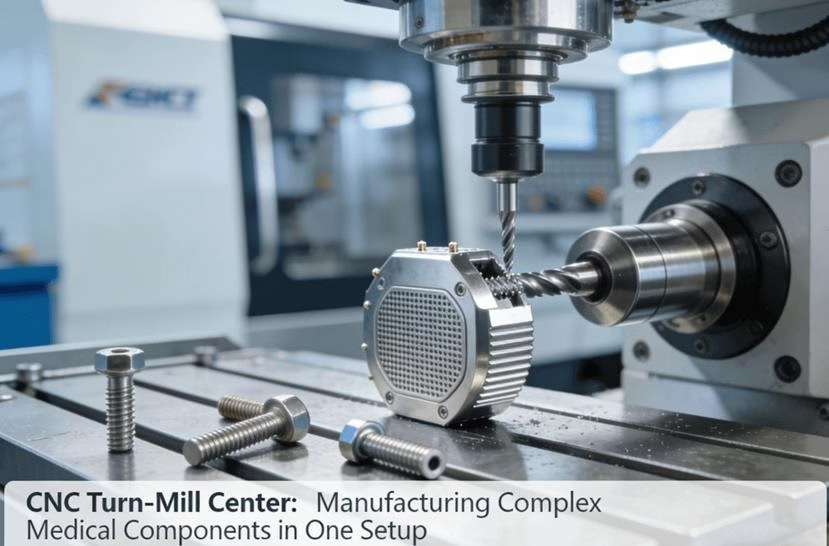
A lot of contemporary medical equipment, for example, surgical hand pieces with nonstandardized flow paths, orthopedic locking plates with nonconforming serrations, or complicated minimally invasive tools, have designs that do not fall within the ambit of both purely turning and milling operations. The conventional approach demands multiple set-ups and machine transfers, which is highly ineffective and prone to increasing the probability of datum errors, leading to poor tolerance of the component.
Here, the CNC Turn-Mill Center emerges as the optimal solution. This advanced platform for Custom CNC Turning Manufacturing integrates turning spindles and milling power heads, enabling the completion of all turning, milling, drilling, and tapping operations—even angled holes—in a single setup. For suppliers offering high-level CNC Turning Services, this means complex parts can be produced monolithically, completely eliminating errors from multiple setups, significantly enhancing the integrity and positional accuracy of complex geometries, while drastically shortening lead times. This is the cutting-edge solution for highly complex medical components. For its core applications in areas like rapid prototyping, see: Core Applications and Advantages of CNC Turn Mill Centers.
How to Assess and Select a Reliable Precision Medical Component Supplier?
A Framework for Evaluation: The Four Pillars of a Reliable Supplier
Selecting a medical component manufacturer requires looking beyond the initial CNC Turning Price. A true partner demonstrates value through holistic capabilities and rigorous process control. Evaluation should rest on four pillars.
l Infrastructure and Certifications
Mandatory ISO 13485 certification is the non-negotiable entry ticket, supported by ISO 9001. Technical capability is proven by advanced multi-axis and CNC Turn-Mill Centers, paired with high-precision metrology like CMMs.
l Process and Collaboration
Traceability of materials and their compliance with biocompatibility standards (e.g., ISO 10993) must be achieved. Additionally, it is vital to involve yourself at an early stage for DFM analysis to maximize reliability, efficiency, and price.
Key Traits of a Reliable Manufacturing Partner
A good manufacturing partner should have Custom Manufacturing services that include everything from prototype design to full-scale manufacturing, offering visibility and control throughout the process. JS Precision, which is certified under ISO 13485 and IATF 16949, is a perfect example of such a partner that provides online CNC turning service consultancy and solutions.
Conclusion
In addition to advances in biotechnology, the progress of modern medicine cannot be achieved without the reliable support of advanced manufacturing technologies. The ability to achieve micron-scale tolerance, as well as the processing of complex materials with precision, allows for the creation of the foundation of future medical devices using advanced CNC manufacturing technology. This technology makes it possible to provide the Physical Basis for Precision Health Technology.
For those who are working on creating the next level of medical devices, it is essential to choose the right manufacturer that can provide advanced CNC services. In order to find a supplier, one should check the technical capabilities and quality standards of the company. It is important to choose companies that provide CNC turning services consultations and CNC machining online turning services.
About the Author
The author is an independent analyst and writer in the sphere of manufacturing industry. His long-term experience includes analyzing the use of advanced manufacturing technologies worldwide, including their implementation in the spheres of aerospace and medicine.
FAQs
Q: What is the main difference between medical-grade CNC machining and normal metal machining?
A: Most of the differences DNA and traceability. For instance, medical-grade machining is one of the most stringent processes around and it takes place in highly controlled or frequency environments, adhere to quality systems such as ISO 13485, ensure biocompatibility, etc. Besides that, they offer these traceability documents that start with raw materials and end with finished parts, whereas the precision requirements are oftentimes at the micron level.
Q: Does CNC machining provide a cheap solution for custom and low-volume medical parts?
A: For prototypes or complicated implant cases, or even niche medical devices CNC machining is very flexible and it doesn’t need the expensive molds, so it is a very cost-effective option in this sense. It also facilitates rapid design iteration and ensures that the low-volume products will be manufactured with the same level of precision and quality as high-volume production.
Q: What steps should be taken to ensure that CNC machined medical parts are sterile?
A: CNC machining does not have the final sterilization step; however, it is imperative that the manufacturing process have a controlled atmosphere to prevent contamination. Following manufacturing, the parts are subjected to rigorous washing procedures that remove residues of cutting fluids and particles. The medical device manufacturer carries out final sterilization using methods that are compliant such as gamma radiation, ethylene oxide or others.
Q: Can complex metal parts intended for human implantation over long periods be machined?
A: Absolutely! State-of-the-art 5-axis CNC milling and turn-mill technologies are capable of directly machining complex trabecular structures or intricate internal cavities from blocks of biocompatible materials, such as titanium or cobalt-chromium alloys. This is yet another significant high-precision solution complementing additive manufacturing.
Q: How do I get a price online for CNC machining? What info do I have to submit?
A: Without a doubt, the best source for online price quotes is a comprehensive submission that includes 3D drawings (e.g. STEP files), the type of material, the surface finish, the number of pieces, and the tightest tolerance. A professional CNC machining company uses these to assess the manufacturability of the part, suggest any necessary design modifications, and give you a fair price quote.